
The sharp end of climate change
Magnifying the voices

Tanzania. Of all the countries I’ve travelled to for work over the years, Tanzania is the one place where I feel nothing but happiness and freedom. I’ve often wondered how a country can have captivated me so entirely that I metaphorically kick my shoes off the moment the plane lands.
I’ve been staying at the same hotel in Dar Es Salaam - The Mediterraneo - for more than 20 years. It’s a laid back place right on the Indian Ocean, a little away from the city craziness. Over the years it has changed in small ways, but its essence of bringing a Mediterranean laid-back vibe to the Swahili coastline remains unwavering.
My last visit was in the Autumn of 2022. I was in Africa for meetings, trying to close the deal on UK government funding for a new programme of climate research collaboration between the UK and East Africa. It was going to be an easy trip for me, mainly because my excellent colleague was doing such a great job of gathering the evidence that would navigate the discussions with people who needed to be persuaded that parting with £11 million would make a substantial change to the work of a new generation of climate researchers. They did eventually fund the programme.
My first stop was Nairobi, and from there I took an early evening flight to Dar. As I boarded that flight I remember thinking what a difficult time I was having, finally acknowledging the impact of far too much stress - my mother had recently died and I was tired from all that entails with sorting through property and bringing back childhood memories, wondering whether giving her 1950’s wedding dress away to a charity shop was the right thing to do (it’s now in the back of my wardrobe whilst I still figure out the answer to that question). To top it all off a very dear colleague and friend who I turned to in moments of professional uncertainty had recently died from cancer. It was easy to feel adrift and exhausted.
But something incredible happened on that short flight.
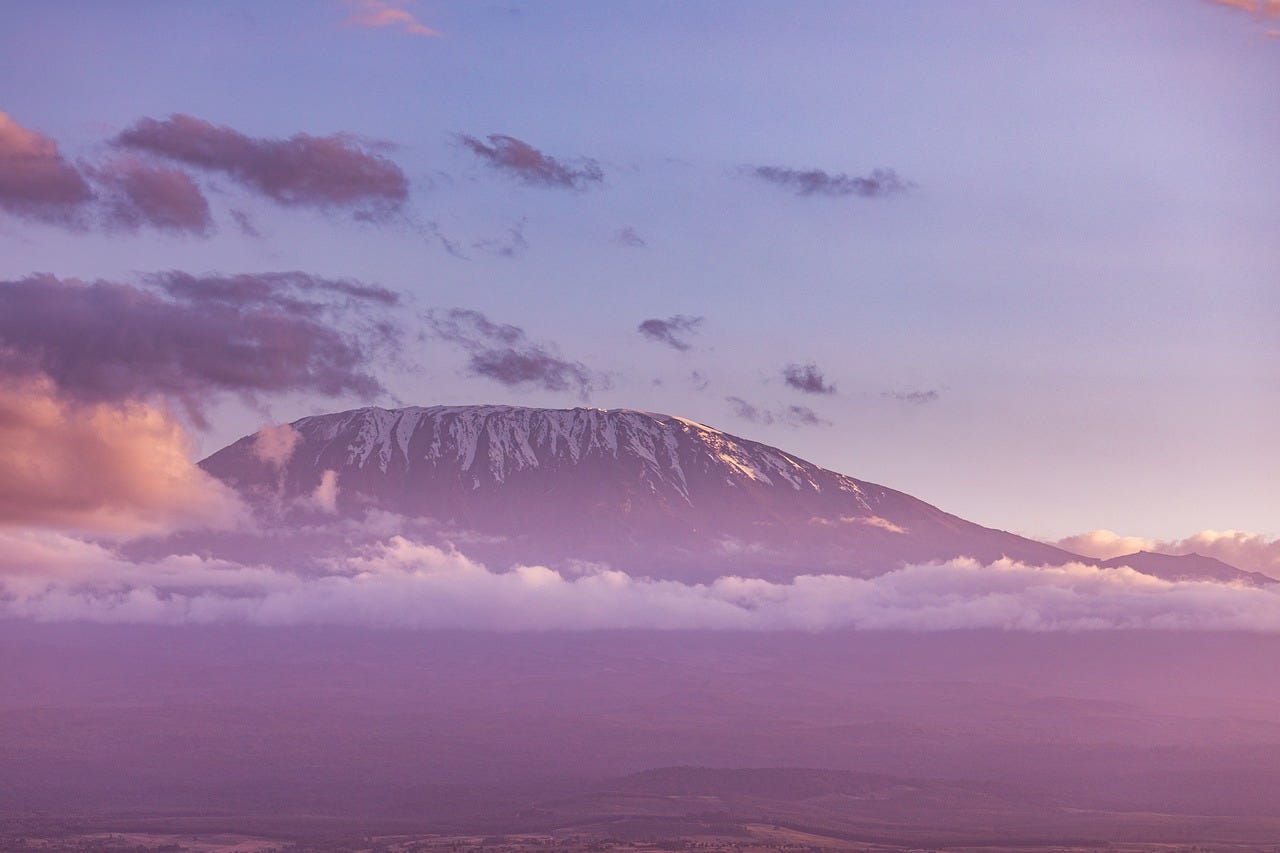
We took off with the sun just starting to set and as those of you who have spent time in Africa will know, there is nothing quite like an African sunset. The sky is just different to the northern hemisphere - somehow it’s bigger, bolder and brighter. I stared out the window and saw something peering out of the low cloud. I asked one of the cabin crew and he said - with the nonchalance of someone who does this route every day - oh that is the peak of Mount Kilimanjaro - an everyday sight for him but a jumping up and down moment for his passenger! There it was, covered in snow and surrounded by low cloud, with the sunset watching over it. One of those rare moments when you can’t help but be amazed by the power and beauty of nature. In the few seconds it took to fly over the mountain, I felt the uncertainty of life lift. It never returned even with the shock of a cancer diagnosis that followed a few months later. Life is tough and I was being confronted by uncertainty but, for reasons perhaps I still don’t fully understand, there was an extraordinary sense of hope and the opportunity to reclaim the creativity and excitement again.
As we drove into Dar and to the hotel, I was struck by a huge change since my last visit just before the pandemic. It had only been three years, but in that short space of time the heavily populated lowlands of the city were being pushed back by the ocean and when I arrived at the Mediterraneo, I saw changes the hotel had taken to keep rising sea levels from damaging the property. The stark reality of climate change on the livelihoods of Tanzanians where so many rely on agriculture and small household businesses in a region where population growth in Sub Saharan Africa is predicted by 2050 to outpace Europe, half of whom will be under 25 years old.
African countries have long been at the sharp end of the impact of climate change and environmental damage, which I have seen in towns and villages across the continent, including the increased displacement of communities. I was struck by conversations on that visit with universities in Kenya about the environmental impact seen in the local communities around Lake Victoria on the Ugandan border due to increased flooding and drought, and discussions with the Irish Ambassador on her recent visit to the famine area across the horn of Africa.
Having worked in all three, the connection between law, social justice and science has always fascinated me. Basic human rights including the rights to education, food, health and clean water - all so intrinsically linked - are under environmental threat in communities around the UK and in so many other countries. So often it is the most disadvantaged and least resilient communities that suffer the greatest impact - they are the voices that are seldom heard yet where the economic, health and wellbeing impact is most keenly felt.

It is absolutely right that action is taken at government level, by setting and being held to account by the law and ambitious national and global targets to tackle the threat from global warming on the environment. Scientists must be funded to continue work on solutions through research and innovation. I don’t buy into the notion that it’s too late for more research. Surely we need to keep exploring, learning and improving our knowledge and how that is translated into action. As I set out in this article for the London School of Economics, science research collaboration between the UK and East Africa on fundamental concerns such as the continued improvement of weather management systems and clean energy was part of continuing to find and improve upon solutions for the current and future generations. Physics is often the overlooked science for so many of the challenges we face.
But it doesn’t stop there. Too often we forget to listen to those who are at the sharp end and equip them with the tools they need to be active citizens in protecting their own environment. In Tanzania, with support from NGOs, there is work being done. The World Wildlife Fund’s Sowing Change programme uses solutions like native plant nurseries and beekeeping to help meet their families’ practical needs for food, school fees, and health care while helping to restore the landscape for future generations. Another group has invested in beehives, which provided income through the sale of honey and candles while also serving as a safeguard to protected forests. As one climate scientist put it - we need to learn to live on the planet - not off it.
It needs more and that is one of the main reasons the Converse Chronicles started, just as I started a series of community conversations for local community groups and scientists in partnership with a national social cohesion organisation. Sometimes it’s a combination of our own small steps that can help to create change. Surely it is the democratic right of communities to be part of conversations, to have greater control in setting the agenda and to take the action when needed to protect their fundamental human rights where they are at risk. They may not be the people taking to the streets in protest, but in the many different challenges human beings face, the greatest positive change I’ve seen is from within those communities - whether in East Africa or on our own doorstep. It starts by listening and supporting people to have a voice and claim some power to bring their own challenge and create change.
How can we support those voices to be heard?
